TECH CONTRIBUTION SERIES ⑤ — SMART FACTORY → DARK FACTORY
Combining AI Guidance process prediction with LLM-based knowledge understanding to connect planning, approval, execution, and verification
3-Second Summary
- An AI Agent is not a manufacturing chatbot / It is an operating system that understands process conditions and documents, calls the required tools, and plans actions.
- RAG connects answers to shop-floor knowledge / It searches manuals, work standards, history, and alarms to provide current evidence and sources together.
- Authority and safety come before equipment control / AI commands should execute only within limited ranges after passing through a policy engine, interlocks, approval, and audit logging.
Autonomy Is Incomplete If People Must Transfer Every Prediction Manually
Even if AI Guidance calculates future quality and optimal conditions, a person remains between decision and execution if an operator must check the screen and enter PLC values manually. This structure is appropriate for initial validation, but as the number of processes, variables, and alarms grows, differences in operator workload and expertise become a new bottleneck.
An AI Agent connects this final link. It reads process data and AI predictions, retrieves the necessary evidence from manuals and work standards, plans the appropriate sequence of actions, and calls approved tools to issue alarms, reports, approval requests, and equipment commands. The essential distinction is not natural-language response, but an actionable plan connected to operational systems.
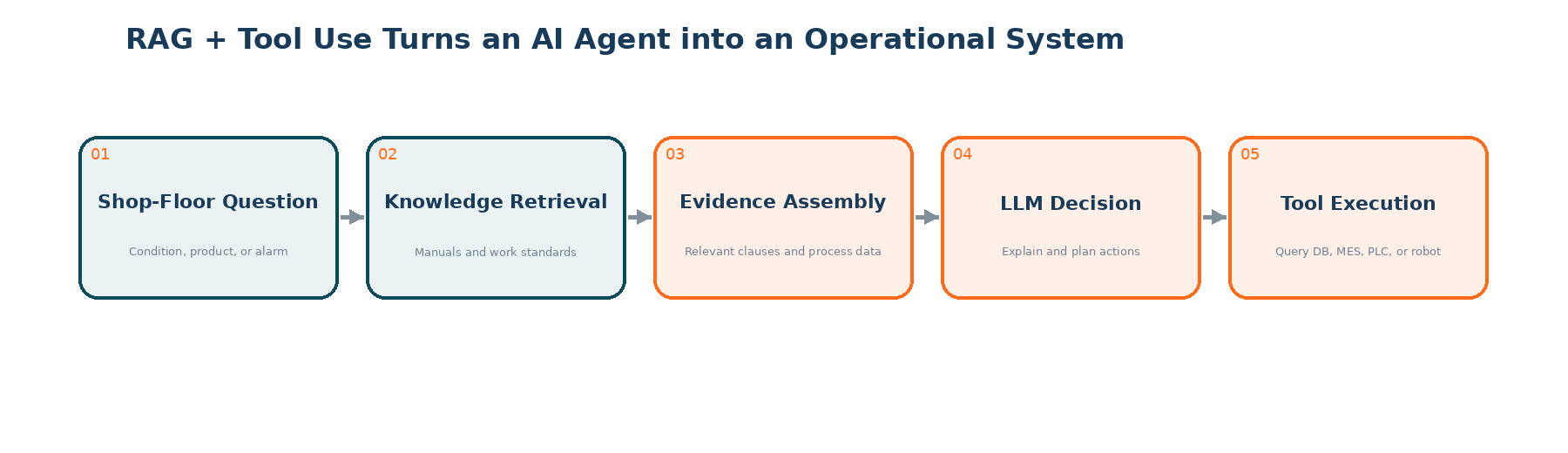
Figure 1. RAG, decision, and tool-execution architecture for a manufacturing AI Agent Source: Reconstructed by ITIV AI
Why Does Manufacturing Need RAG?
Large language models learn general knowledge, but they do not automatically know company-specific equipment names, process criteria, current work standards, customer quality specifications, or real-time production conditions. Retrieval- Augmented Generation (RAG) first searches documents relevant to a question and then includes the retrieved evidence in the LLM input when generating an answer.
The original RAG paper proposed a structure that retrieves explicit, non-parametric external memory for knowledge-intensive tasks, rather than relying only on knowledge stored in model parameters.[^1] In manufacturing, manuals, SOPs, checklists, failure history, quality specifications, and process data form this external knowledge. When a document is revised, the retrieval source can be updated without retraining the entire model, and operators can verify the answer against the cited evidence.
| Knowledge source | Example data | AI Agent application |
|---|---|---|
| Work standards and manuals | Operating procedures, inspection sequence, and safety rules | Present situation-specific action procedures and evidence |
| Process and equipment data | Temperature, pressure, current, alarms, and predicted quality values | Judge current conditions and possible anomaly causes |
| Operating history | Past failures, operator actions, outcomes, and shift records | Retrieve similar cases and prioritize actions |
| Quality specifications | Product-specific criteria, customer requirements, and tolerances | Verify the suitability of recommendations and inspection results |
| System authority | User, equipment, command, and approval scope | Restrict executable tools and command ranges |
An AI Agent Alternates Between Reasoning and Action
ReAct research proposed alternating language-model reasoning with actions in an external environment. Reasoning tracks plans and exceptions, while action obtains additional information from a knowledge base or environment to improve the next decision.[^2] A manufacturing AI Agent should likewise repeat status queries, evidence retrieval, planning, tool calls, and result verification rather than ending with a single response.
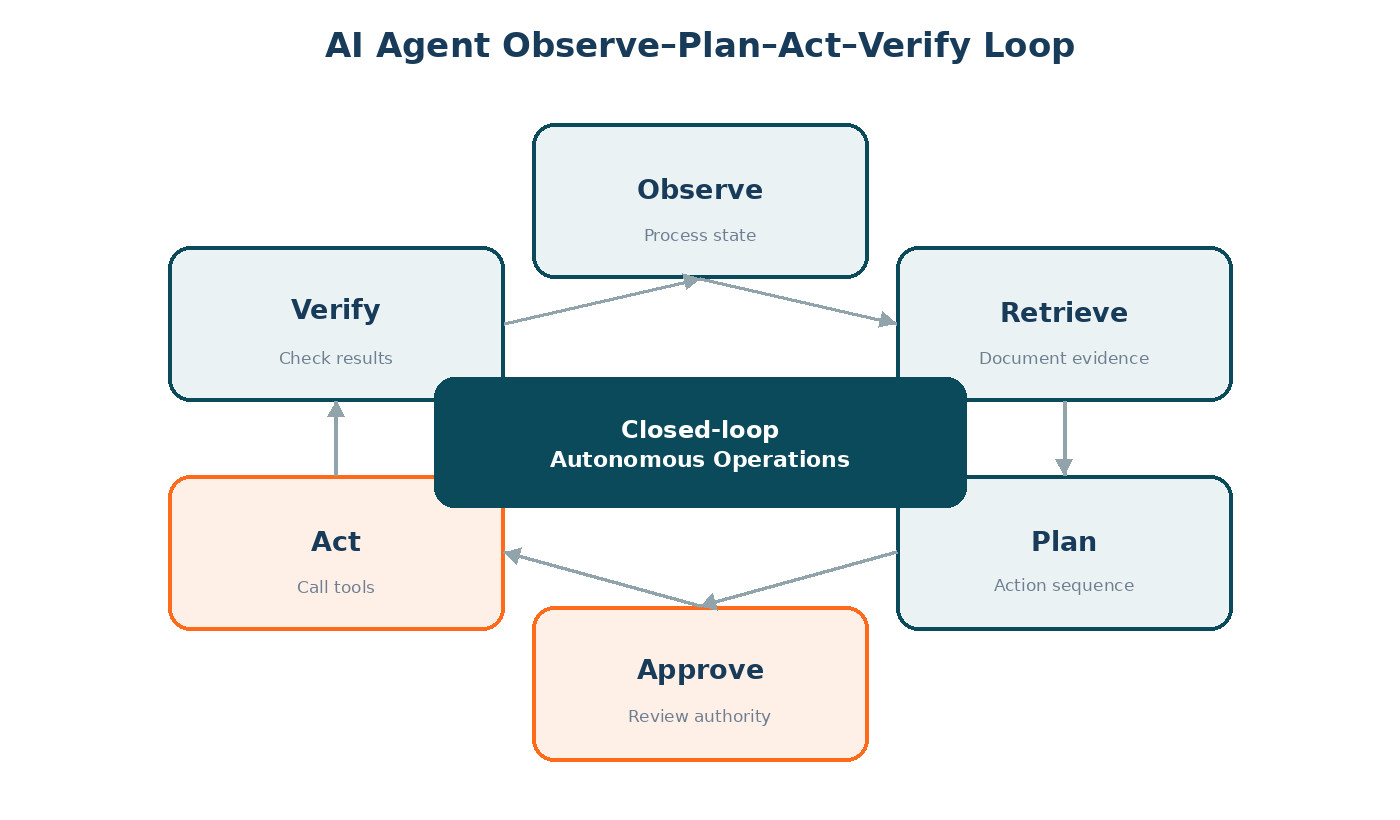
Figure 2. Repetitive execution cycle of a manufacturing AI Agent Source: Reconstructed by ITIV AI from the ReAct concept for manufacturing operations
For example, when a predicted quality value approaches an upper limit, the Agent first checks sensor and model status and retrieves the work standard and similar past cases for the product. It then verifies whether the adjustment recommended by AI Guidance satisfies equipment limits and safety policy, and either requests operator approval or performs a limited automatic change. After the change, it reviews the predicted and actual results again and records whether the action succeeded.
Manufacturing AI Is Expanding from Analytical Models to Agents and Generative AI
The World Economic Forum reported that analytical AI and machine learning accounted for approximately 62% of 2025 Lighthouse solution categories, while generative AI accounted for 23%. Generative-AI use cases are increasing rapidly, but analytical AI for process prediction, quality, and optimization still forms the largest foundation.[^3]
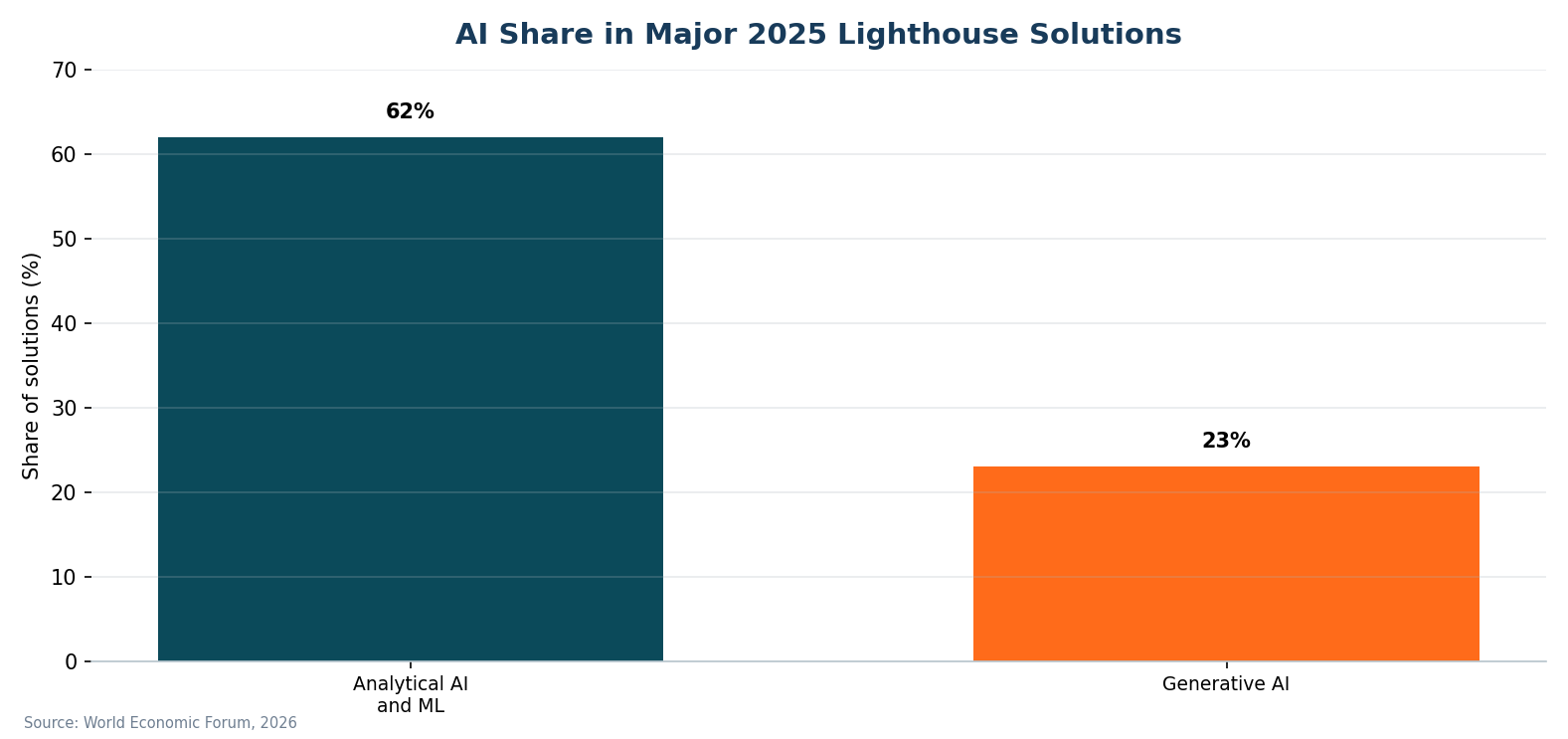
Figure 3. AI composition of major Global Lighthouse Network solutions Source: World Economic Forum, 2026
These figures do not mean that AI Agents replace existing predictive models. A manufacturing Agent is best designed to connect validated analytical models—such as quality prediction, anomaly detection, optimization, and vision inspection—as tools beneath the LLM’s document-understanding and planning capabilities. When the values calculated by AI Guidance are combined with work knowledge understood by the LLM, the system can support both natural-language explanation and process execution.
Battery Manufacturing Case Connecting LLMs, AI, and Self-Optimization
The EVE Energy Jingmen case introduced by the World Economic Forum deployed more than 40 digital solutions, including AIoT, simulation, LLMs, and AI, to implement real-time quality diagnosis, process self-optimization, and predictive maintenance. The defect rate decreased by 52%, unit conversion cost by 41%, and average OEE improved to 88%.[^4]
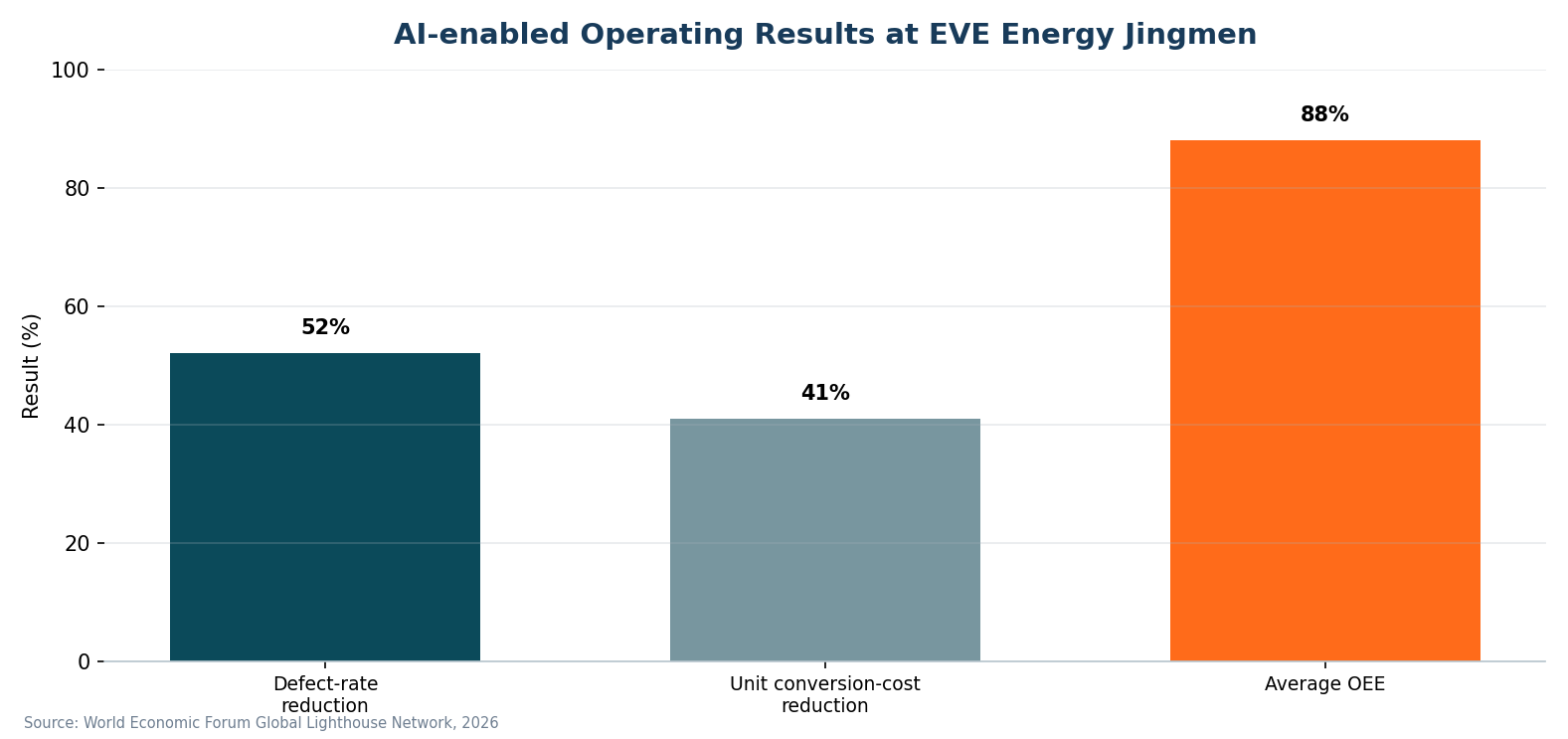
Figure 4. Battery-plant results from combining LLMs, AI, quality diagnosis, and process self-optimization Source: World Economic Forum, 2026
This case should not be interpreted as the independent effect of an LLM alone. It resulted from building sensors and AIoT, simulation, quality models, equipment operations, and organizational capabilities together. The value of a manufacturing Agent is to connect existing analytical models and operating systems through natural language and planning, making shop- floor response faster and more consistent.
A Policy Engine and Interlocks Must Precede Equipment Control
| Control layer | Role | What AI can do | Blocking condition |
|---|---|---|---|
| Information layer | Query and explain shop-floor data | Summarize conditions, suggest causes, and provide document evidence | Missing data or model error |
| Recommendation layer | Recommend adjustments and procedures | Recommend decrease, hold, increase, and inspection sequence | Insufficient confidence or unclear specification |
| Policy layer | Validate commands and authority | Check allowable range by equipment, user, and product | No authority, out of range, or prohibited condition |
| Safety layer | Interlocks, emergency stop, and independent protection | Block hazardous commands independently of AI | Safety sensor or protection logic activated |
| Execution layer | Execute PLC, robot, and MES commands | Run validated commands and collect results | Response failure or state mismatch |
| Audit layer | Record all decisions and executions | Store evidence, approval, command, result, and model version | Missing logs or insufficient traceability |
NIST SP 800-82 Rev. 3 explains that OT systems directly change the physical environment and therefore require security that accounts for performance, reliability, and safety requirements.[^5] When an AI Agent calls a PLC or robot, stricter authority controls, network segmentation, command validation, recovery procedures, and audit logging are required than in general IT automation.
AI commands must never bypass an independent safety PLC or existing interlocks. Natural language or code generated by an LLM should not be sent directly to equipment. Tool interfaces should be restricted to predefined functions and parameter ranges. High-risk commands may require two-person approval, time limits, and integration with work-permit procedures.
Autonomous Control Authority Should Expand in Stages
- Stage 1 — Explain / The Agent organizes the condition, possible causes, and supporting documents, while the operator makes the decision.
- Stage 2 — Recommend / The Agent presents the AI Guidance adjustment and expected effect, and the operator approves it.
- Stage 3 — Approved execution / The Agent sends approved commands to PLC or MES and records the result automatically.
- Stage 4 — Limited autonomy / The system adjusts automatically under normal conditions and within narrow approved ranges, escalating only exceptions.
- Stage 5 — Multi-process autonomy / The system links and optimizes quality, production, and energy objectives across multiple processes.
Promotion from one stage to the next should be based on operational evidence, not conversational quality. KPIs such as recommendation approval rate, execution success rate, reduction in specification deviations, number of safety blocks, model drift, and manual-recovery time should be validated over a defined period before authority is expanded.
Items That Must Be Verified in a Manufacturing AI Agent PoC
| Area | Verification item | Validation question |
|---|---|---|
| Knowledge | Document currency, version, authority, and source | Can the evidence and applicable document version behind an answer be traced? |
| Data | Real-time capability, missing data, and ID mapping | Does the Agent query the correct condition of the product and equipment in question? |
| Tools | Allowed functions, parameters, and error handling | Does the Agent call only defined tools and detect failures? |
| Safety | Policy, interlocks, approval, and manual fallback | Does an incorrect recommendation or communication failure terminate in a safe state? |
| Evaluation | Answer accuracy, evidence quality, execution success rate, and operational KPIs | Do good answers lead to shorter response time and lower variability? |
| Audit | Log, model, document, user, and command history | Can the organization reproduce who executed what, why, and with which evidence? |
Key Conclusion
A manufacturing AI Agent is not a chatbot that answers questions about documents. It is an operating system that reads process data, retrieves evidence, plans actions, and safely executes a limited set of tools. Authority, interlocks, and auditability come before the speed of autonomous control.
In Closing

References and Sources
※ External figures and cases in this article were compiled from official publications by institutions and companies and from the supplied product brochures. ITIV AI visually reconstructed the charts and diagrams from the original figures or technical structures.
Bibliography
- NIST, “AI Risk Management Framework: Generative AI Profile”. Reference: reliability, risk management, evaluation, and validation requirements for generative AI. Link
- ITIV AI, “AI Solutions Overview.” Reference: the direction of manufacturing-system integration through an AI Agent that combines AI Guidance and LLM technology. Link
[1] Lewis et al., “Retrieval-Augmented Generation for Knowledge-Intensive NLP Tasks”. Reference: the RAG architecture that retrieves external non-parametric knowledge and combines it with generation. Link [2] Yao et al., “ReAct: Synergizing Reasoning and Acting in Language Models”. Reference: an Agent architecture that alternates reasoning with external actions. Link [3] World Economic Forum, “Global Lighthouse Network: Transforming advanced manufacturing”. Reference: analytical AI and ML accounted for approximately 62% of 2025 Lighthouse solutions and generative AI for 23%. Link [4] World Economic Forum, “EVE Energy - Jingmen”. Reference: real-time quality diagnosis, self-optimization, and predictive-maintenance results using AIoT, simulation, LLMs, and AI. Link [5] NIST, “SP 800-82 Rev. 3: Guide to Operational Technology Security”. Reference: security and control principles that account for OT performance, reliability, and safety requirements in PLC and SCADA environments. Link
※ The control-authority stages and policy layers are illustrative examples from ITIV AI’s technical perspective. Actual sites require separate validation based on equipment risk and customer safety regulations.